
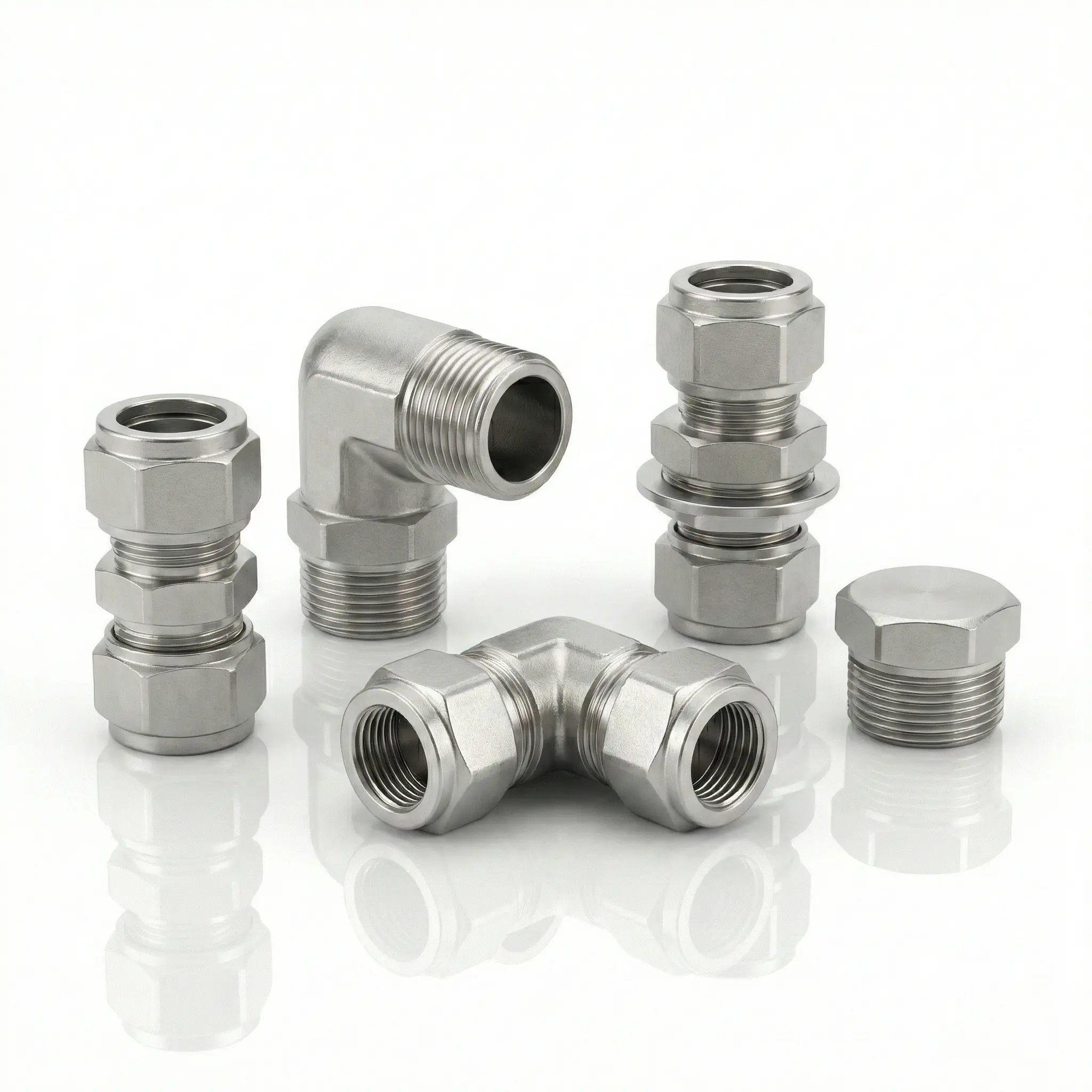
Tube fittings are high-performance connectors designed to join thin-walled tubing without the need for welding or threading the tube itself. Unlike standard pipe fittings, which deal with larger schedules, tube fittings are engineered for precision applications where a gas-tight, vibration-resistant seal is mandatory. They are widely used in instrumentation, hydraulic, and pneumatic systems where reliability is non-negotiable.
The Compression Technology
The most common and reliable design is the Double Ferrule Compression Fitting:
- Front Ferrule: Creates a pressure-tight seal against the fitting body and the tube’s outer diameter.
- Back Ferrule: Grips the tube firmly to provide mechanical support and vibration resistance, preventing the tube from “blowing out” under pressure.
- Nut: Provides the mechanical force required to compress the ferrules onto the tube.
Key Technical Specifications
- Materials: Primarily Stainless Steel 316 for corrosion resistance, though Brass, Monel, and Hastelloy are used for specific chemical compatibility.
- Configuration: Includes Unions, Male/Female Connectors, Elbows, Tees, Crosses, and Bulkhead fittings.
- Size Range: Fractional sizes (1/16″ to 2″) and Metric sizes (2mm to 50mm).
- Pressure Ratings: Capable of handling pressures from vacuum up to 15,000 PSI, depending on the tube wall thickness and material.
Primary Applications
Tube fittings are the standard for critical “Small Bore” piping:
- Instrumentation: Connecting pressure gauges, transmitters, and sensors to process lines.
- Analytical Equipment: Used in Gas Chromatography (GC) and laboratory gas manifolds.
- Hydraulic Systems: Powering machinery and actuators in aerospace and heavy industry.
- CNG & Hydrogen: Handling high-pressure alternative fuels in transport and refueling stations.
Why Use Tube Fittings?
- Easy Installation: Requires only a wrench; no heat, sparks, or specialized welding certifications needed.
- Reusability: Most high-quality tube fittings can be disassembled and remade multiple times without compromising the seal.
- Vibration Resistance: The double-ferrule design “deadens” vibration, preventing fatigue cracks at the connection point.