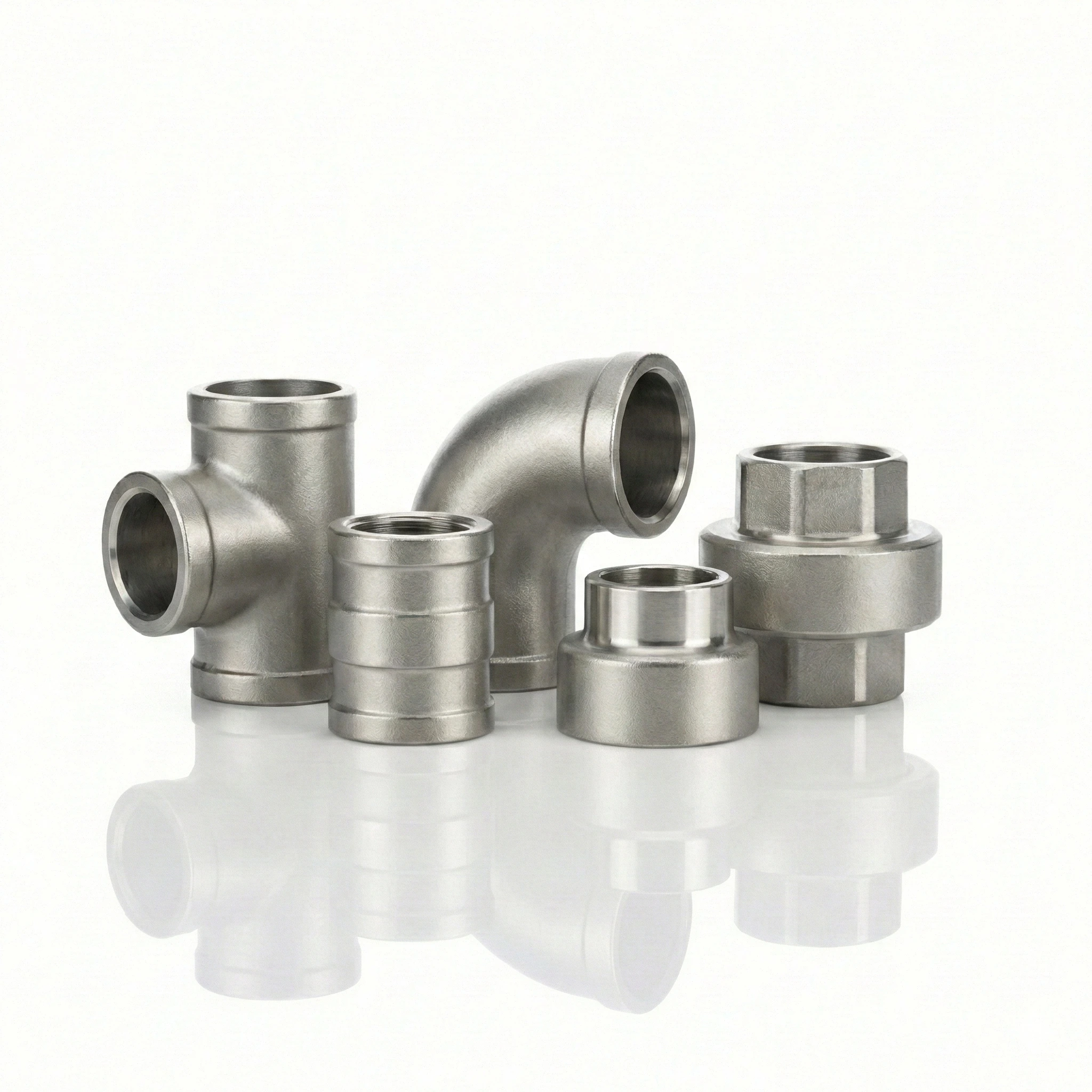
Olets (also known as branch connection fittings) provide a rugged, self-reinforced way to create a branch from a larger “header” pipe to a smaller “outlet” pipe. Unlike standard tees, Olets are designed to integrate directly onto the run pipe, minimizing stress concentrations and providing superior structural integrity in high-pressure and high-temperature systems.
The Primary “Olet” Family
Each type is named based on how it connects to the branch pipe:
- Weldolet®: The most common type; it uses a buttweld connection for maximum strength.
- Sockolet®: Features a socket-weld outlet for smaller-diameter branch lines.
- Thredolet®: Designed with a female threaded (NPT/BSPT) outlet for easy assembly.
- Latrolet®: Used for making 45° lateral branch connections.
- Elbolet®: Specifically designed to be installed on the back of a 90° elbow.
Key Specifications
- Standards: Manufactured according to MSS-SP-97, which covers dimensions and pressure-temperature ratings.
- Materials: Carbon Steel (ASTM A105), Stainless Steel (F304/F316), and Alloy Steel (F11/F22).
- Classes: Typically available in 3000# and 6000# for threaded/socket types, while Weldolets match the schedule of the pipe (e.g., Sch 40, Sch 80, Sch XXS).
Core Applications
Olets are indispensable in heavy-duty industrial piping:
- Oil & Gas: High-pressure manifolds and pipeline branching.
- Refineries: Managing flow in catalytic cracking and distillation units.
- Power Plants: High-pressure steam headers and boiler feed systems.
- Chemical Processing: Critical branch points where leak prevention is vital.
Advantages Over Standard Tees
- Cost-Effective: Often cheaper and faster to install than cutting a large pipe for a standard tee.
- Space-Saving: Requires much less space than a full-size tee fitting.
- Reinforcement: The heavy base naturally reinforces the hole cut in the header pipe.