
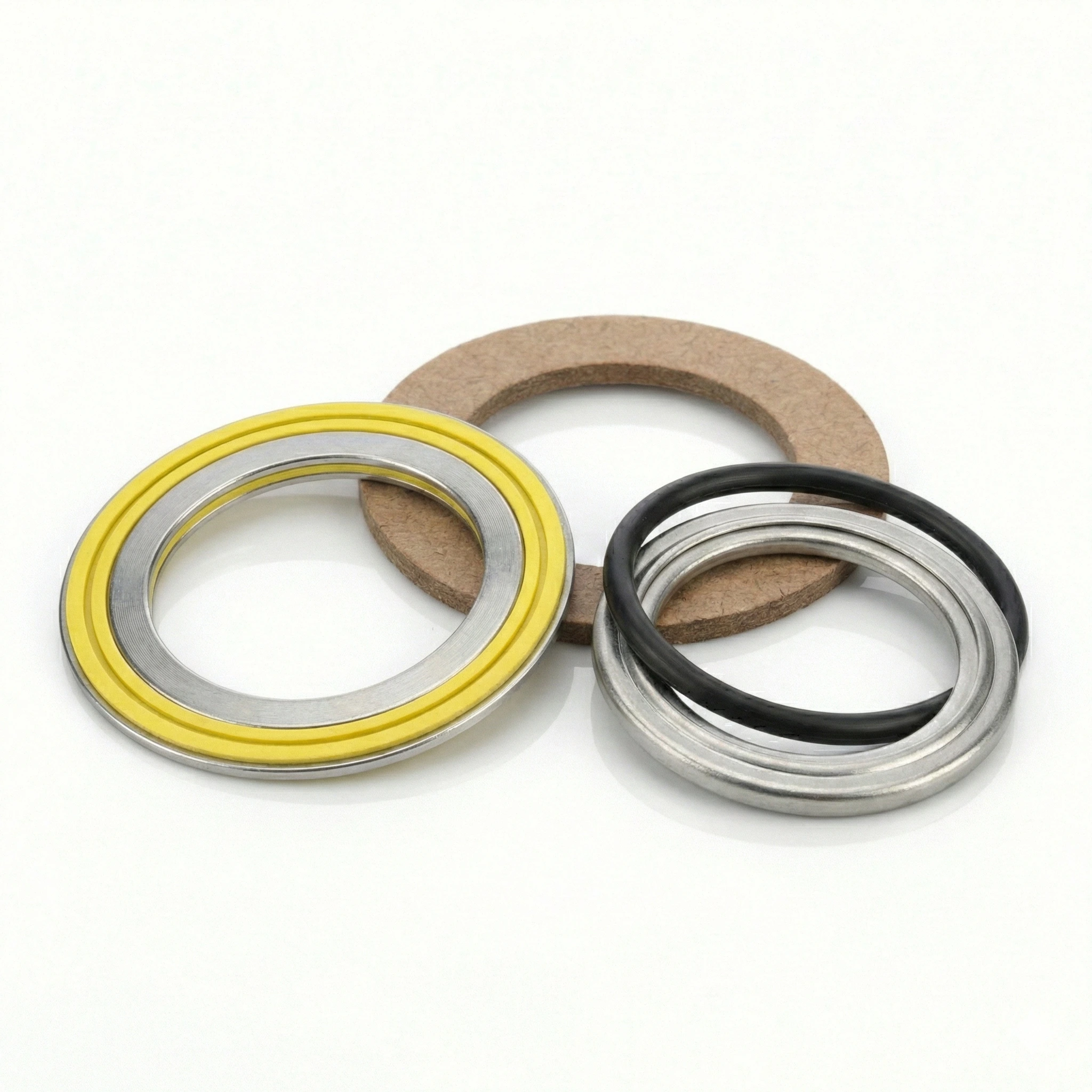
Gaskets are mechanical seals designed to fill the space between two or more mating surfaces, such as flanges, to prevent leakage while under compression. In the world of industrial piping, the gasket is the “sacrificial” component—it is softer than the flanges it joins, allowing it to deform and fill microscopic irregularities in the metal surfaces to create a gas-tight or liquid-tight barrier.
Core Types & Their Roles
- Spiral Wound Gaskets (SWG): The most common metallic gasket. It features a V-shaped metal strip spirally wound with a filler material (like Graphite or PTFE). Best for high-pressure and high-temperature fluctuations.
- Ring Type Joint (RTJ): A solid metal ring (usually Octagonal or Oval) that fits into a machined groove in the flange face. Reserved for extremely high-pressure applications (Class 600# and above).
- Non-Asbestos Sheet Gaskets: Made from compressed fibers with an elastomer binder. Ideal for low-to-medium pressure systems like water, steam, or air.
- PTFE (Teflon) Gaskets: Known for exceptional chemical resistance. Used primarily in the chemical and pharmaceutical industries where corrosion is a major concern.
- Rubber/Neoprene Gaskets: Flexible and cost-effective; used for low-pressure water lines and plumbing.
Key Technical Specifications
- Standards: Manufactured according to ASME B16.21 (for non-metallic) and ASME B16.20 (for metallic/spiral wound).
- Pressure Ratings: Designed to match flange classes from 150# to 2500#.
- Materials: * Fillers: Flexible Graphite, PTFE, Ceramic.
- Winding Metal: Stainless Steel (304, 316, 321), Monel, or Inconel.
- Dimensions: Available in Full Face (covering the entire flange) or Inner Ring/Ring Type (fitting inside the bolt circle).
Primary Applications
Gaskets are the silent guardians of system integrity in:
- Oil & Gas Refineries: Preventing volatile leaks in high-heat distillation units.
- Chemical Plants: Sealing joints that transport aggressive acids or solvents.
- Power Plants: Maintaining pressure in high-pressure steam and boiler systems.
- Food & Beverage: Using FDA-approved materials to ensure sanitary processing.
Why Selection is Vital?
- Leak Prevention: Proper material choice prevents “blowouts” that can cause fires or environmental hazards.
- Chemical Compatibility: Ensuring the gasket doesn’t degrade when in contact with the transported fluid.
- Temperature Resilience: Maintaining a seal even as the piping expands and contracts during thermal cycles.