
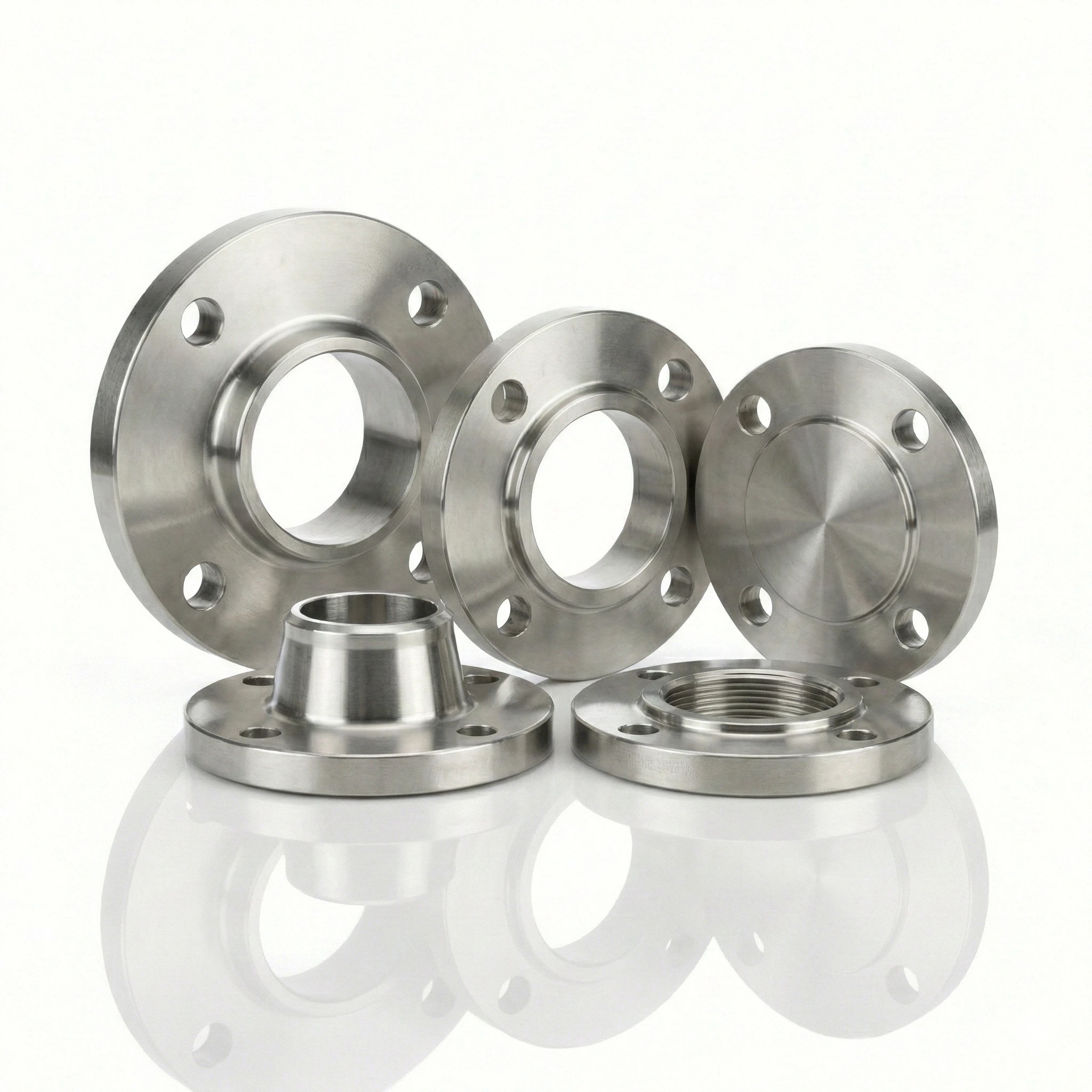
Flanges: The Critical Connectors in Industrial Piping
Flanges are forged or cast rings designed to connect pipes, valves, pumps, and other equipment to create a piping system. They provide easy access for cleaning, inspection, or modification because they can be dismantled without cutting the pipe. Flanges are typically used in pairs and bolted together with a gasket in between to create a high-integrity, leak-proof seal.
Core Types & Their Roles
- Weld Neck (WN): Features a long tapered hub that is welded to the pipe. Best for high-pressure and extreme temperature services.
- Slip-On (SO): Slipped over the pipe and welded both inside and out. Popular for low-pressure applications due to ease of alignment.
- Blind (BL): Used to seal the end of a piping system or vessel opening. Essential for pressure testing and future expansions.
- Socket Weld (SW): Pipe is inserted into a socket and welded. Common for small-diameter, high-pressure piping.
- Lap Joint (LJ): Used with a “stub end” for systems requiring frequent dismantling and alignment.
Key Technical Specifications
- Dimensions & Standards: Manufactured primarily under ASME B16.5 (up to 24″) and ASME B16.47 (for larger diameters).
- Pressure Ratings: Standardized into “Classes” — 150#, 300#, 600#, 900#, 1500#, and 2500#.
- Face Types: Available in Raised Face (RF) for general use, Flat Face (FF) for cast iron equipment, and Ring Type Joint (RTJ) for very high-pressure applications.
- Common Materials: Carbon Steel (ASTM A105), Stainless Steel (F304/F316), and Alloy Steel.
Primary Applications
Flanges are the standard choice for connectivity in:
- Oil & Gas Refineries: Connecting large-bore pipelines to storage tanks.
- Water Treatment Plants: Facilitating the maintenance of high-volume pumps and valves.
- Chemical Industry: Managing hazardous fluid transport where frequent cleaning is required.
- HVAC & Firefighting: Securely joining large-scale piping in commercial buildings.
Why Choose Flanges?
- Flexibility: Allows for easy disassembly of sections for maintenance.
- Alignment: Easier to align than welded joints in complex layouts.
- Structural Integrity: Provides a robust mechanical joint capable of handling significant vibration and pressure.